Skip to content
Metal Melee

Constructed / Illustrated tabletop guide / 2–4 players

Build your own strategy.

Choose your decks before the match, pair them with the right Plants, and make every card work together.

01

Build your strategy

Constructed lets you plan your combinations before sitting down to play. Additional game copies may be needed for your chosen decks.

  1. Build a 40-card Foundry from Units: Bots, Titans and any included Special Units.
  2. Build a separate 15-card Research deck from Pilots and Utilities.
  3. Use cards from one core set and up to one expansion.
  4. Choose Power Plants that support your deck’s costs and effects. Begin with one face-up, Charged Primary and one face-down Secondary.
Every player uses a separate 40-card Foundry and 15-card Research deck.
Every player uses a separate 40-card Foundry and 15-card Research deck. Tap the illustration to enlarge.
Build with a plan. Fast attackers, protective front-row Bots, heavy units and Research combinations support different paths to victory.

02

Prepare the table

  1. Attach one EMP Charge to your Primary Plant. Use Overcharged EMP with four players.
  2. Shuffle Foundry and Research separately, and leave space for your face-up Junkyard.
  3. Shuffle the shared Boon Cache. Each player keeps their own active Boons, but none is active at the start.
The draw Cache is shared, but active Boons belong to individual players.
The draw Cache is shared, but active Boons belong to individual players. Tap the illustration to enlarge.

03

Roll and draw

  1. Roll to determine who plays first.
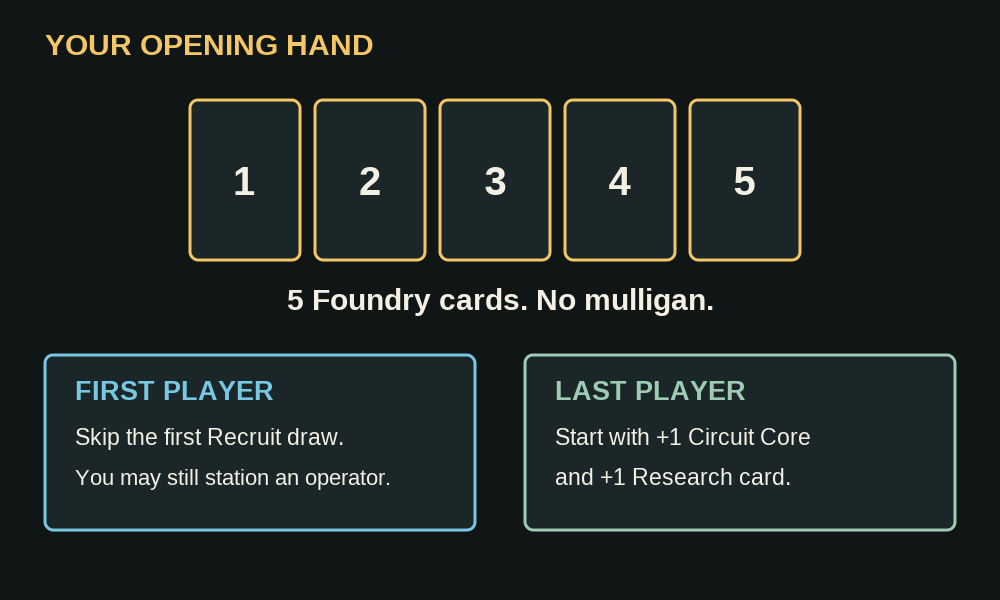
  2. Draw five Foundry cards. There is no mulligan.
  3. Give the last player one Circuit Core and one Research card.
  4. The first player skips their first Recruit draw, but may still station an operator.
Five Foundry cards form your opening hand. Apply the first- and last-player adjustments.
Five Foundry cards form your opening hand. Apply the first- and last-player adjustments. Tap the illustration to enlarge.

04

Learn your Dashboard

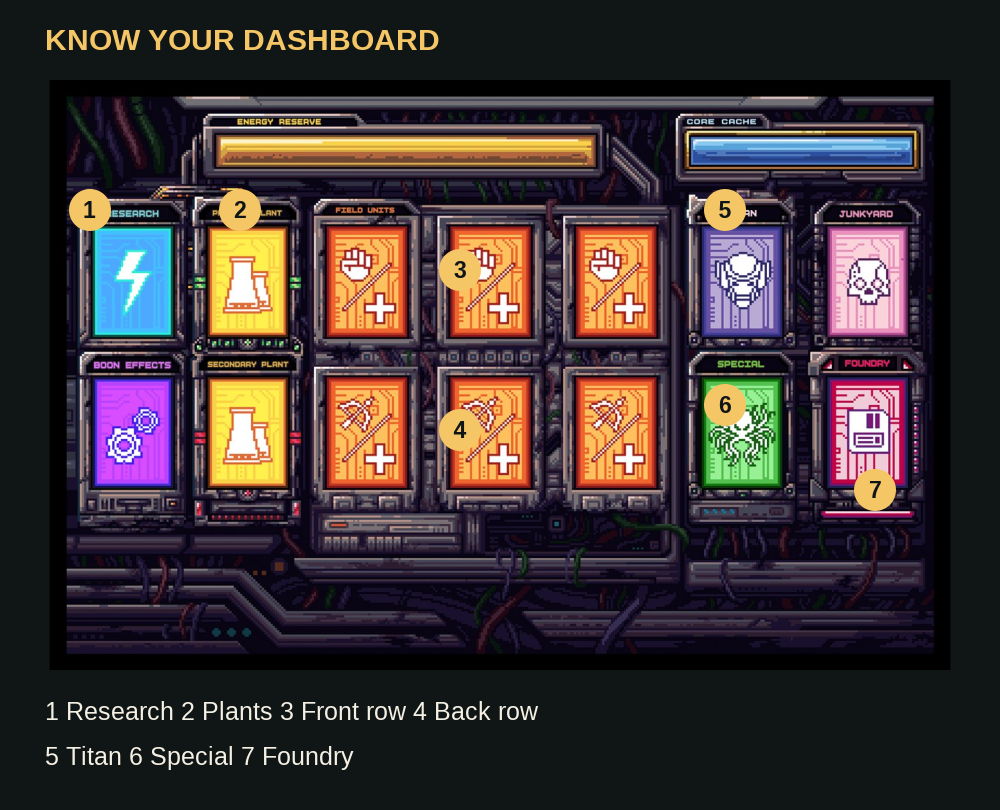
The Bot field is two rows of three spaces. Melee Bots enter the front row; Ranged Bots enter the back row; Support Bots may enter either row. You need an empty legal space.

Titans and Special Units use their own slots outside the Bot field. They are not adjacent to, or obstructed by, Bots. Keep Foundry, Research and your face-up Junkyard separate.

The current Dashboard artwork shows the separate card zones. The numbered callouts identify the spaces.
The current Dashboard artwork shows the separate card zones. The numbered callouts identify the spaces. Tap the illustration to enlarge.

05

Take a turn in six phases

Beginning

Starting with the active player and proceeding clockwise, remove one Overclock counter from each applicable unit and resolve its effects. After its final counter’s effects finish, scrap it. Overclock advances on every player’s turn.
Charge

Charge your units and Plants. A Stunned card instead clears all Stun counters and stays Depleted for this charge event.

Recruit

Draw two Foundry cards, then optionally station one Unit or Pilot at an inactive Plant. Each operator adds one production; an inactive Plant holds up to five. The first player skips only the first Recruit draw.

Energy Production

Set your Reserve to total Plant production, including operators and current modifiers.

Action

Spend resources to play cards, attack and activate abilities. Pay all costs and finish each action and its triggered effects before starting another.

End

Resolve end-of-phase effects, discard down to seven, clear unused Energy and check victory.
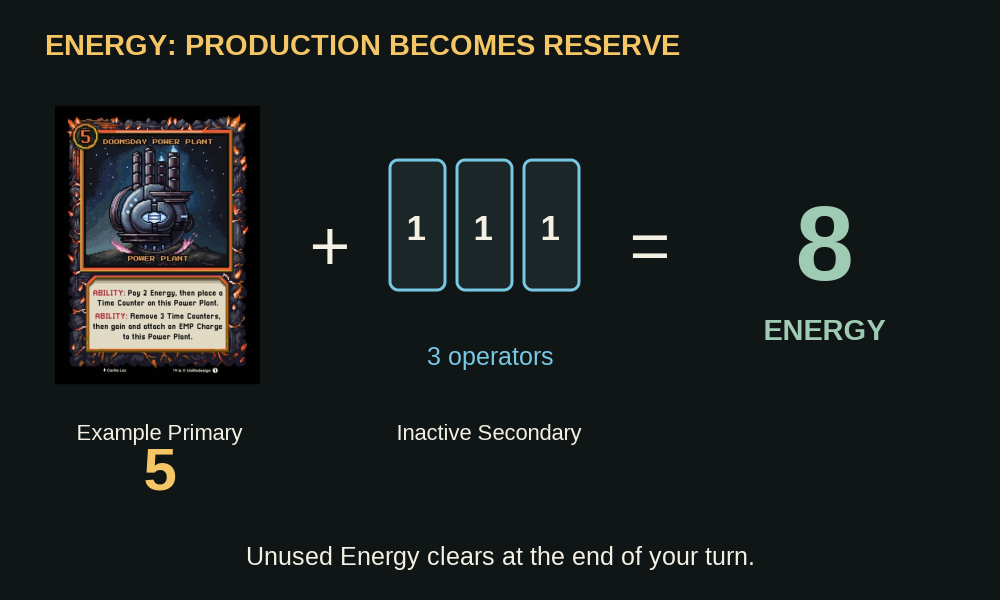
Example: a Plant producing five plus three operators produces eight Energy.
Example: a Plant producing five plus three operators produces eight Energy. Tap the illustration to enlarge.
Secondary Plant activation: an inactive Plant must be Charged before activation. Follow its activation cost, then flip it face up without depleting it. Its printed production starts at your following Energy Production phase, not immediately.

06

Play cards and pay costs

Units

Pay the cost and place the unit in an empty legal space. Units enter Depleted unless their text says ENTERS CHARGED or an effect changes this. Kaiju cost Circuit Cores; spending Cores reduces your progress toward victory.

Pilots

Attach to a matching unit type, with no more than one Pilot per unit. The Pilot goes to the Junkyard when its host leaves play.

Utilities

Play on your turn, resolve the effect and place the Utility in your Junkyard.

Abilities

Use Charged cards during your Action phase. Pay every listed cost and deplete the acting card. If you cannot pay the full cost, you cannot begin.

Passive and triggered effects can work while a card is Depleted. The active player chooses the order of simultaneous automatic effects; resolve them before another action.
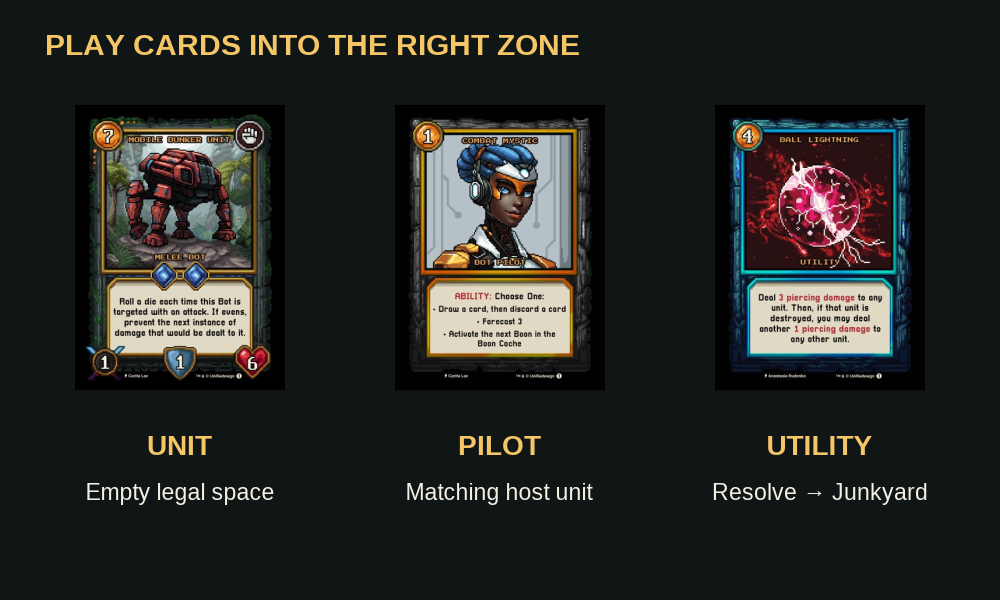
Card types determine where a played card goes.
Card types determine where a played card goes. Tap the illustration to enlarge.
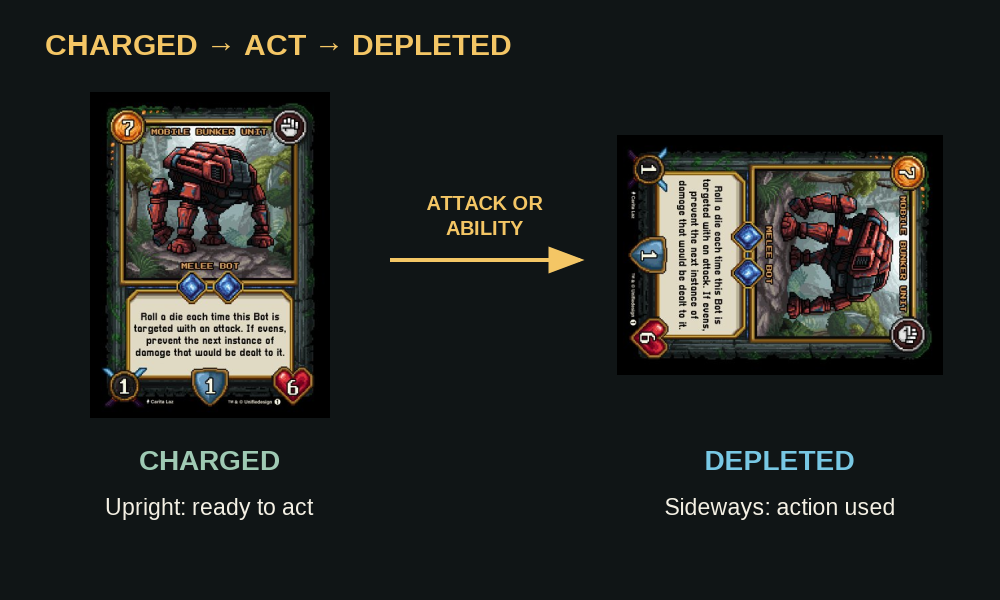
A Charged card turns sideways when used to attack or activate an ability.
A Charged card turns sideways when used to attack or activate an ability. Tap the illustration to enlarge.
Ordinary attacks and targeted effects cannot choose a back-row Bot that has a front-row Bot in the same column. Look for the keyword "target" to know that this "obstruction rule" applies, but cards that specify "any" unit can choose obstructed units.

07

Attack, damage, Research

  1. Choose a Charged attacker and a legal target. Deplete the attacker by turning it sideways, indicating that it has used its action and can't act again until charged. A front-row Bot obstructs the back-row Bot in its column; an effect that explicitly chooses “any” unit may bypass obstruction.
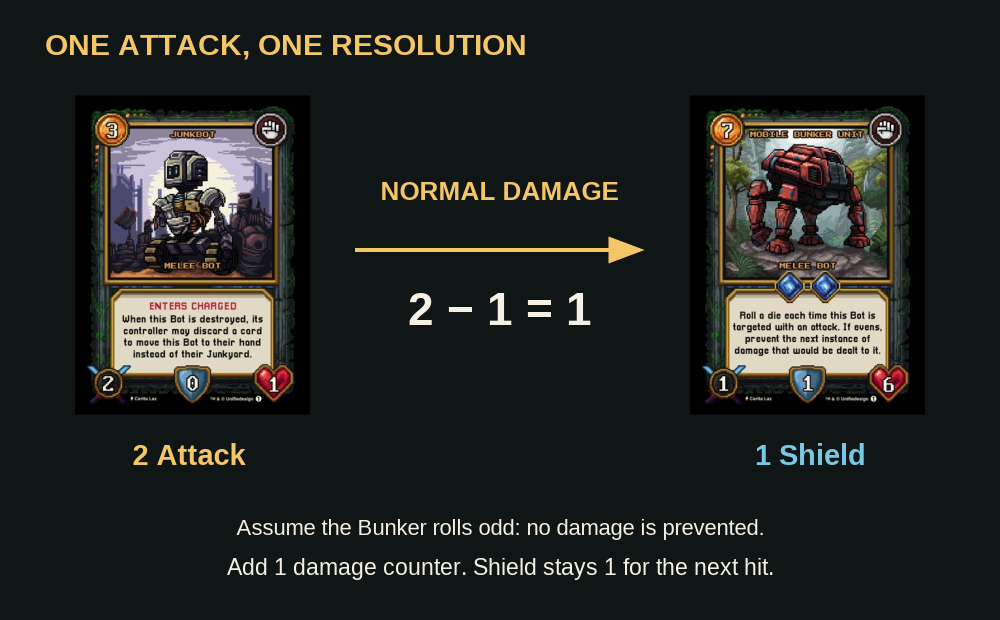
  2. Normal damage is Attack − Shield, minimum zero. Add that many damage counters. Shield applies again to every hit and is not spent. Piercing ignores Shield.
  3. Damage remains until removed. When damage reaches Health, the unit is destroyed. Resolve the whole action and its effects before choosing another.
Worked example from the rulebook. The Bunker’s prevention effect is assumed not to prevent this hit.
Worked example from the rulebook. The Bunker’s prevention effect is assumed not to prevent this hit. Tap the illustration to enlarge.
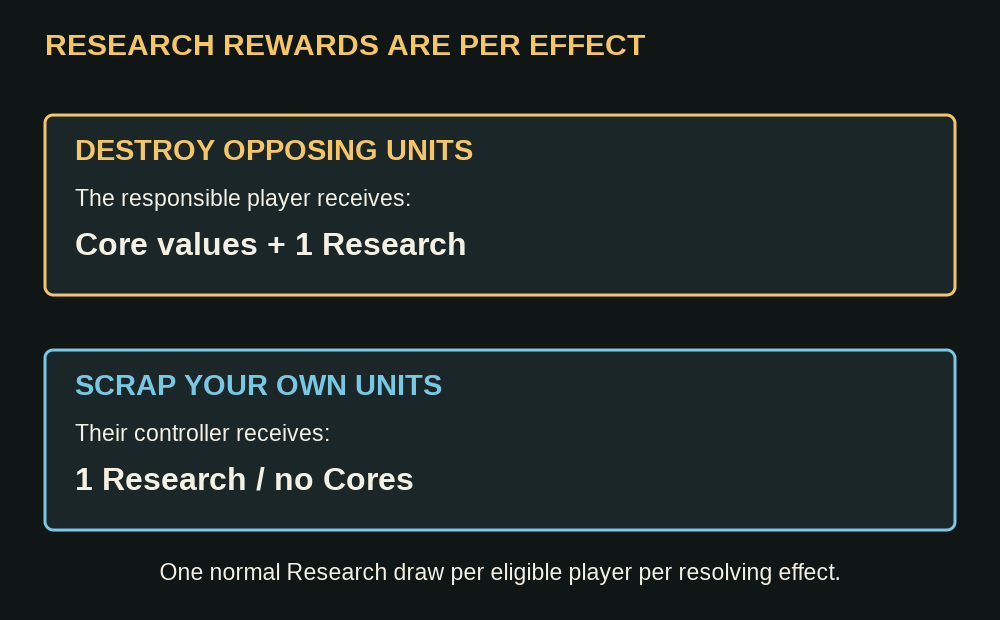
Scrap and destruction are different. One effect can remove several units but still awards only one normal Research draw per eligible player.
Scrap and destruction are different. One effect can remove several units but still awards only one normal Research draw per eligible player. Tap the illustration to enlarge.

Destroying opposing units awards their Core values to the responsible player. One effect destroying one or more opposing units also gives that player one normal Research draw. One effect scrapping one or more of your units gives you one normal Research draw after resolution, but no Cores.

Separate effects can award separate draws; explicit extra draws remain additional. Empty Research gives no card and does not end the game. Discarded cards, attachments and operators entering the Junkyard are not destroyed or scrapped units.

08

Gain a Boon. Time your EMP.

Successfully play a Titan or Kaiju from your hand to receive the next Boon from the shared Cache. Players may have any number of active Boons. New Boons do not replace existing Boons. Resolve it before the unit’s entry-triggered effects.

Destroying a heavy unit neither awards nor removes a Boon. Passive Boon effects belong to the holder and check the current board. Recycle inactive Boons when the Cache empties.

Keep all your active Boons. There is no active Boon limit.
Keep all your active Boons. There is no active Boon limit. Tap the illustration to enlarge.

Standard EMP: spend one EMP Charge and deplete its Charged active Plant to Stun one opponent’s units and Plants. It deals no damage by default.

Four-player Overcharged EMP: follow the attachment’s alternative ability, including scrapping your units to Stun all opponents’ units and Plants. Card effects may modify an EMP.
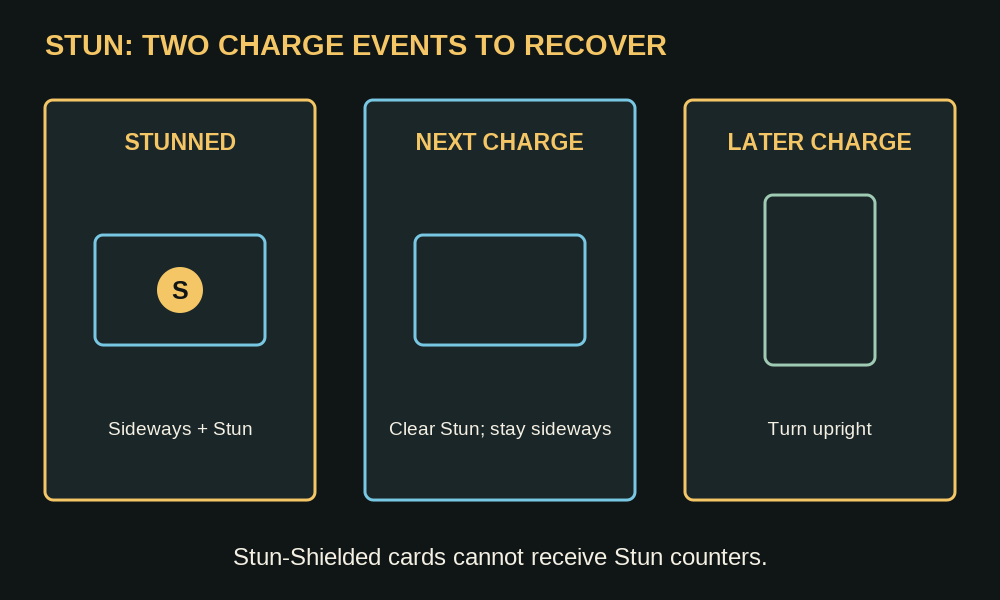
The next charge event clears Stun instead of readying the card. A later charge event can ready it.
The next charge event clears Stun instead of readying the card. A later charge event can ready it. Tap the illustration to enlarge.

Stun-Shielded prevents Stun. Card text takes priority when it explicitly creates an exception.

09
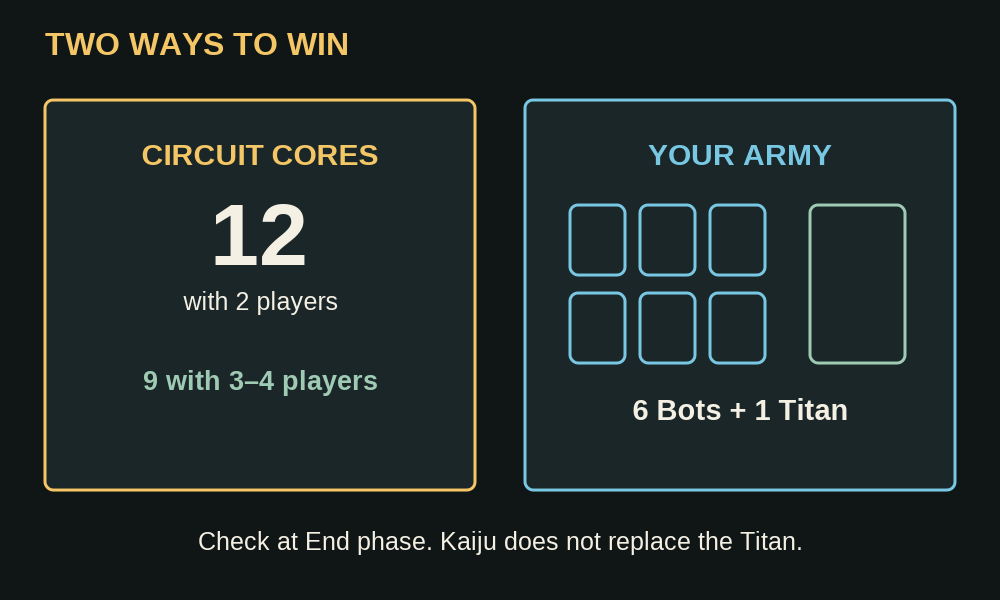
Finish the game

At End phase, check Cores or your army. A Kaiju does not substitute for the Titan.
At End phase, check Cores or your army. A Kaiju does not substitute for the Titan. Tap the illustration to enlarge.

When several players qualify in the same End phase, the active player wins if they qualify. Otherwise compare the qualifying players’ Core totals, then their controlled units. If still tied, the game is a draw.

Foundry exhaustion: if a required Foundry draw cannot be completed, compare Cores, then controlled units. A remaining tie is a draw. Empty Research does not end the game.
Keyword reference: Retaliate, Deathburst and Overclock

RETALIATE X: return X Piercing damage to another unit that dealt positive damage to this unit, including lethal damage and unit abilities. Retaliate can trigger Retaliate; obstruction does not block it. Zero, prevented and self-inflicted damage do not trigger it. Stunned units cannot Retaliate. Only damage received triggers Retaliate; placing other types of counters does not.

DEATHBURST X: when an opponent destroys the unit, its controller may deal X Piercing damage to an unobstructed unit controlled by that opponent. Scrapping does not trigger it.

OVERCLOCK X: enter with X counters. Remove one at every player’s Beginning phase, resolve its effects and scrap the unit after the final counter’s effects finish.

For a card-specific question, contact the team or ask the community.

These guides use the current rulebook text. Card-specific effects may create exceptions. Illustrations show game artwork and schematic examples; card art may change before release.